By continuing your navigation on this website, you accept the use of cookies for statistical purposes.
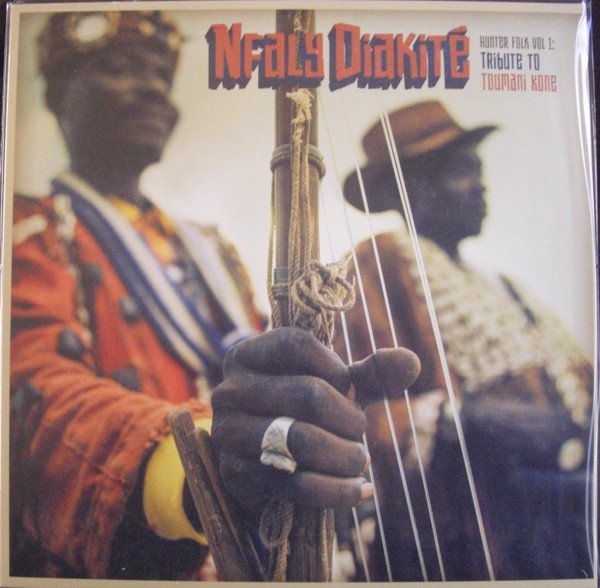
Nfaly Diakité
Hunter Folk Vol I: Tribute To Toumani Kone
Born in 1989 in Bamako, Mali, Nfaly Diakité is a member of the Donsow, Bambara animist hunters. Nfaly Diakité is named after his grandfather, the late Nfaly Diakité, one of Mali’s most respected donso chiefs. His grandfather did not play, but as a leading figure in the donso brotherhood, he was always accompanied by musician Yoro Sidibé. Nfaly grew up alongside Yoro Sidibé, who became his first master of the donso ngoni, a type of eight-stringed antelope skin harp. After leaving school to devote himself to his instrument, Nfaly continued his apprenticeship with Diakaria Diakité and Oumar Sidibé, two donso masters from the Wassolo region.
He quickly made a name for himself in the donso community and was much asked to play at the traditional ceremonies of his brotherhood. He then met percussionist Ibrahim Sarr and joined the BKO Quintet, with whom he recorded an album and toured Europe and the United States. His virtuosity on the donso ngoni soon attracted attention, and he took part in numerous music and dance festivals in Mali and abroad, with the aim of raising awareness of this little-known traditional instrument.
Nfaly Diakité is also a Kônô, meaning that he is responsible for passing on the history and culture of the Bambara people through music and song. He pursues his mission by combining tradition with more contemporary sounds and by collaborating with artists from a wide range of musical backgrounds. For him, music is a means of conveying messages of peace, love and harmony, and his compositions evoke the values of respect, tolerance and open-mindedness.
‘Tribute to Toumani Koné’ is Nfay Diakité’s first solo album, recorded in Bamako in June 2020. On the album, Nfaly is the only singer, providing backing vocals and playing the donso ngoni and keregne. The album is a tribute to the storyteller and poet Toumani Koné, the greatest donso ngoni player since N’gonifo Bourama. Nfaly Diakité is a representative of the new generation of donso ngoni players and he wishes to pay tribute to Toumani Koné, who throughout his long career has been a symbol of courage, daring, loyalty and honesty.
The nine-track of this solo album leaves no room for hesitation. Three instruments (donso ngoni, voice and keregne) manage to carry one into another dimension without ever tiring. The fitting and precise rhythm is a deep but melodious transe. Nfaly’s voice plays between expressive urgency and calm wisdom, and the choruses with his own voice multiply the planes of dimension of the music. The donso n’goni, of which Nfaly is an excellent player, sounds rough and earthy but always clear and sharp. All the strength of a music that does not belong to a single musician but to a long cultural tradition of which he is the spokesman is expressed here. The young Nfaly, thanks to his experience and sensitivity, succeeds on his own in pushing us into this world without feeling the weight of tradition but only the liberation of music that sounds all the more contemporary. This album is to be listened to in its entirety as one tight journey between repeated formulas, highlights and moments of rest within the same relentless rhythm. The densest moment is probably found in the heart of the album, between the tracks Nankama (the predestined one) and Mogote Diabeye (no one can please everyone). Here, the message, which can be deciphered from the translation of the lyrics, seems to transcend language barriers and intepret us directly about our human condition, urging us to move our bodies to the dense rhythm of life.
DONSOYA
(THE HUNTERS’ BROTHERHOOD)
The Donsoya, the hunter’s brotherhood, is a centuries-old tradition in Mali. The members of this brotherhood, the donsow, are considered to be the guardians of Malian tradition and culture. They are also known for their divination and healing abilities, through practices such as dance, song, the use of medicinal plants, as well as amulets and talismans. The donsow are initiated at an early age and follow a rigorous process involving rituals, ceremonies and teachings.
The whole philosophy of the donsoya (literally, the consciousness is there) is developed in the songs of the donso ngoni folaw (the hunters’ praisers). Based on certain themes common to the organisation of all societies (destiny, life, death, love, etc.), the donso ngoni folaw tell us how the initiates of the Mandé, a cultural region located between Mali, Guinea and Côte d’Ivoire, see the world.
The donso ngoni folaw play an essential role for the whole of Mandé society, beyond their brotherhood. True educators, they combine the repetition of traditional formulas and phrases with free texts, which are nevertheless circumscribed by certain themes. In the donso foli (hunters’ music), it is the present that defines the future, but that future cannot exist without the presence of the ancestors who speak to us through the ngoni players. Everything is regulated by the complementarity and polarity of the elements, the instruments and the functions of men and women.
With the crisis raging in Mali, it seems necessary to reconnect with the original vision of the world provided by the donsoya, a philosophy of the Manding world that is rich in meaning but not easy to decipher and bring up to date. Popularising and disseminating donsoya music is a step towards building the world of tomorrow, a world based on respect and trust, free from the ravages of money, and enabling the people of the Mande to grow in the spirit of their ancestors.
crédits
paru le 27 septembre 2024
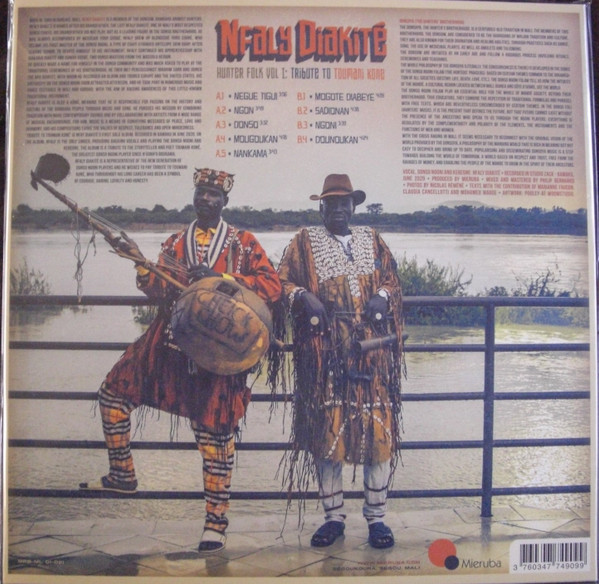
A1
Negue Tigui
A2
Ngon
A3
Donso
A4
Mougoukan
A5
Nankama
B1
Mogote Diabeye
B2
Sadionan
B3
Ngoni
B4
Dounoukan